sulat.com · closed alpha
Sulat will never write it for you.
Paste in something you wrote. Ninety seconds later you get a structured critique of how to shape it better: where the argument sags, where three sentences open the same way, where your reader quietly gives up. Not one sentence comes back replaced.
AI-assisted writing.
Critiqued writing, through AI.
Marks currently on this page
compositing the page…
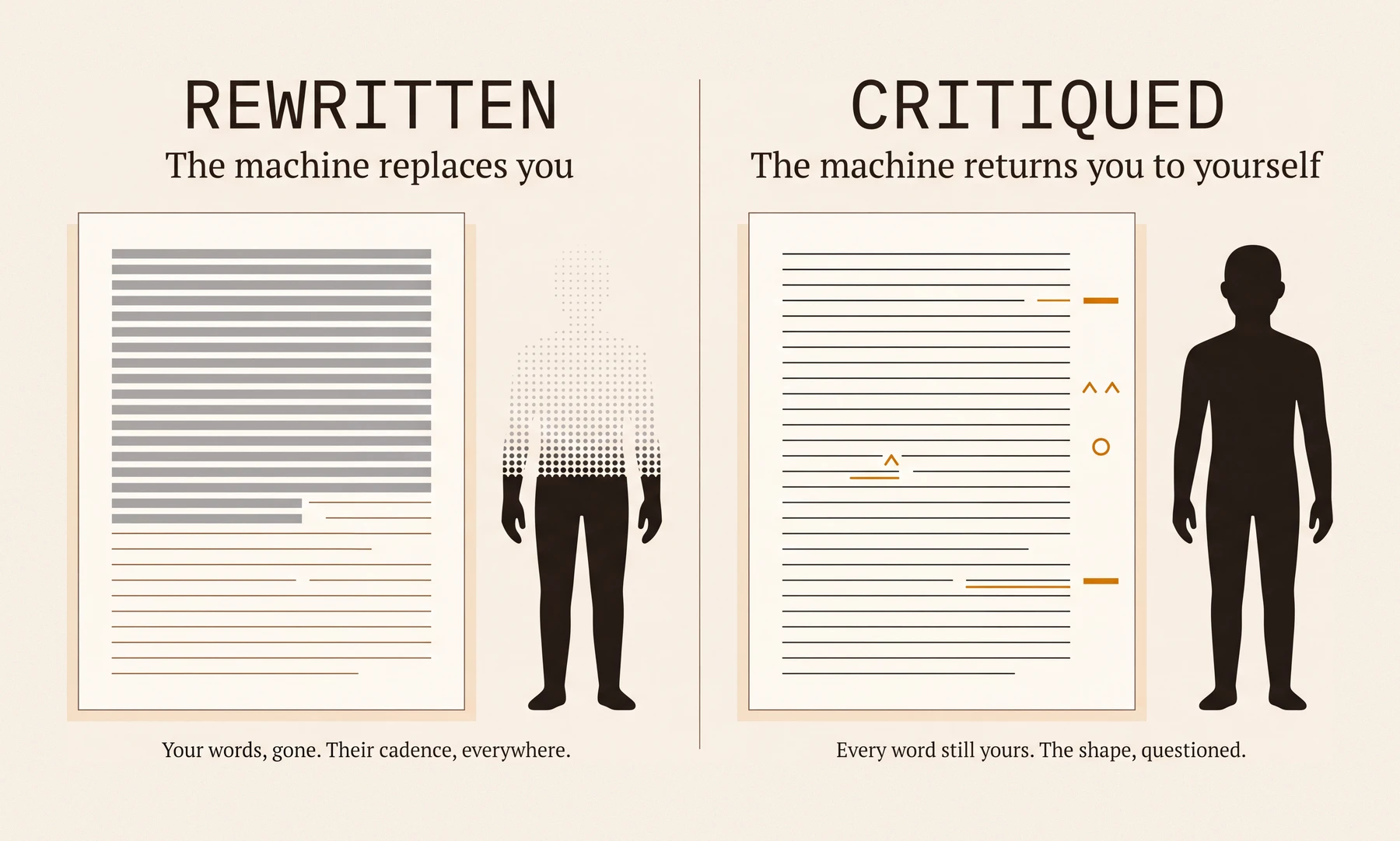
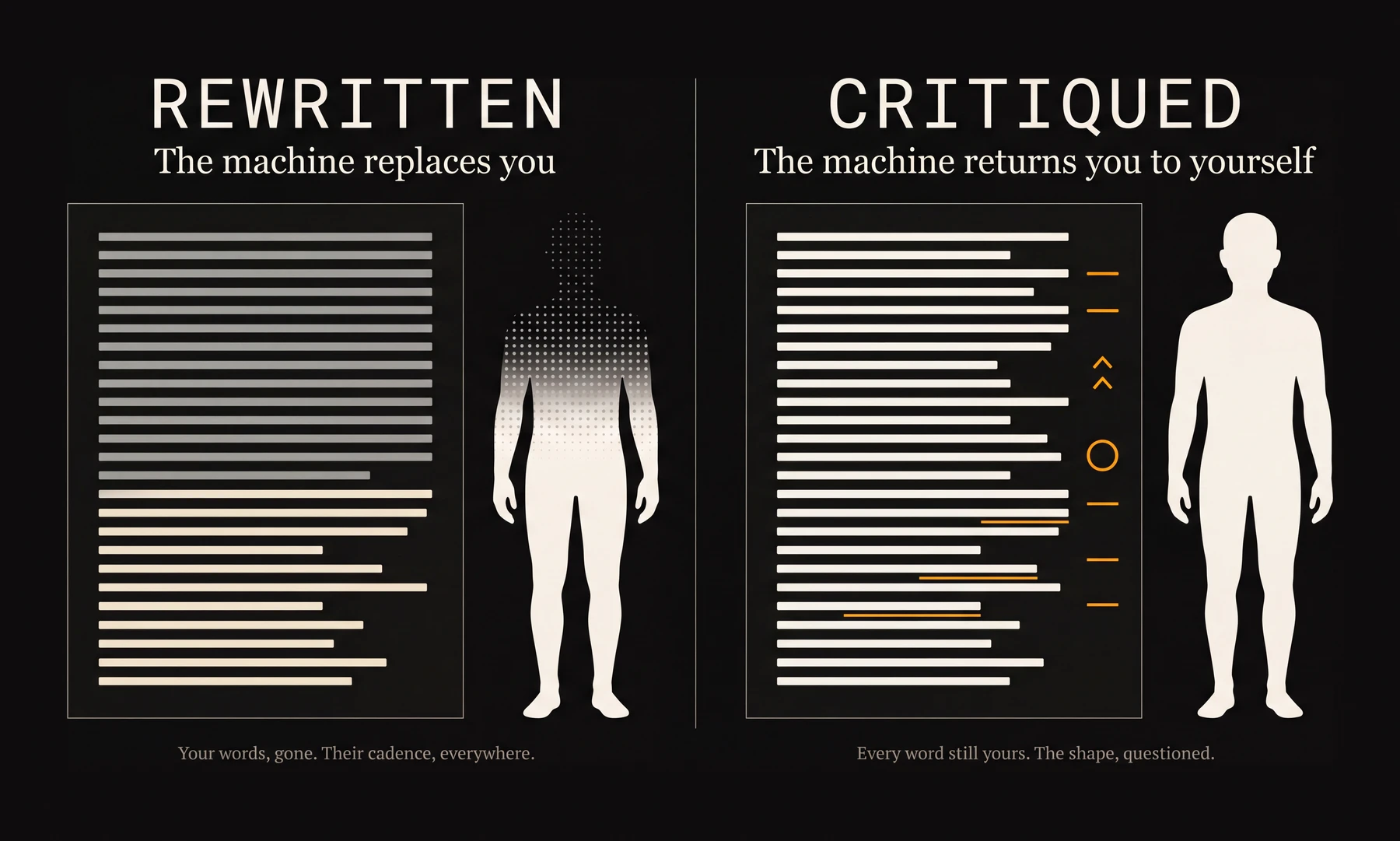
Keep goingA rewrite gives you a better document. A critique gives you a better writer.
Those two things feel identical the first time and completely different by the tenth. Sulat only does the second one.
What a rewrite costs
You hand over a paragraph and get back one that is smoother, flatter and anonymous. It reads well. It reads like everyone. Do it for a year and you lose the thing you were actually being paid or read for, which was never fluency — it was that the sentences could only have come from you.
What a critique returns
You hand over the same paragraph and get it back untouched, with the weak joints marked and named. The third sentence is carrying two ideas. The opening apologises for the claim underneath it. You do the fixing, which is the only part that ever taught anybody anything.
Your draft · unchanged
We shipped the new onboarding flow last Tuesday and honestly the numbers are better than I expected, though I want to be careful about reading too much into a week of data, because we also happened to run a promotion at the same time which probably did some of the work, so the honest answer is that we don’t fully know yet.
What a rewriting tool hands back
We launched our redesigned onboarding flow last Tuesday, and early results are encouraging. However, it is important to note that a concurrent promotional campaign may have contributed to the observed uplift. Further analysis is therefore required before drawing definitive conclusions.
Nothing above was written for you. Every word in that sequence is lifted from your own draft. Sulat proposes the order and the break points. You decide whether it is right.
Your draft doesn’t go to one model and come back with an opinion.
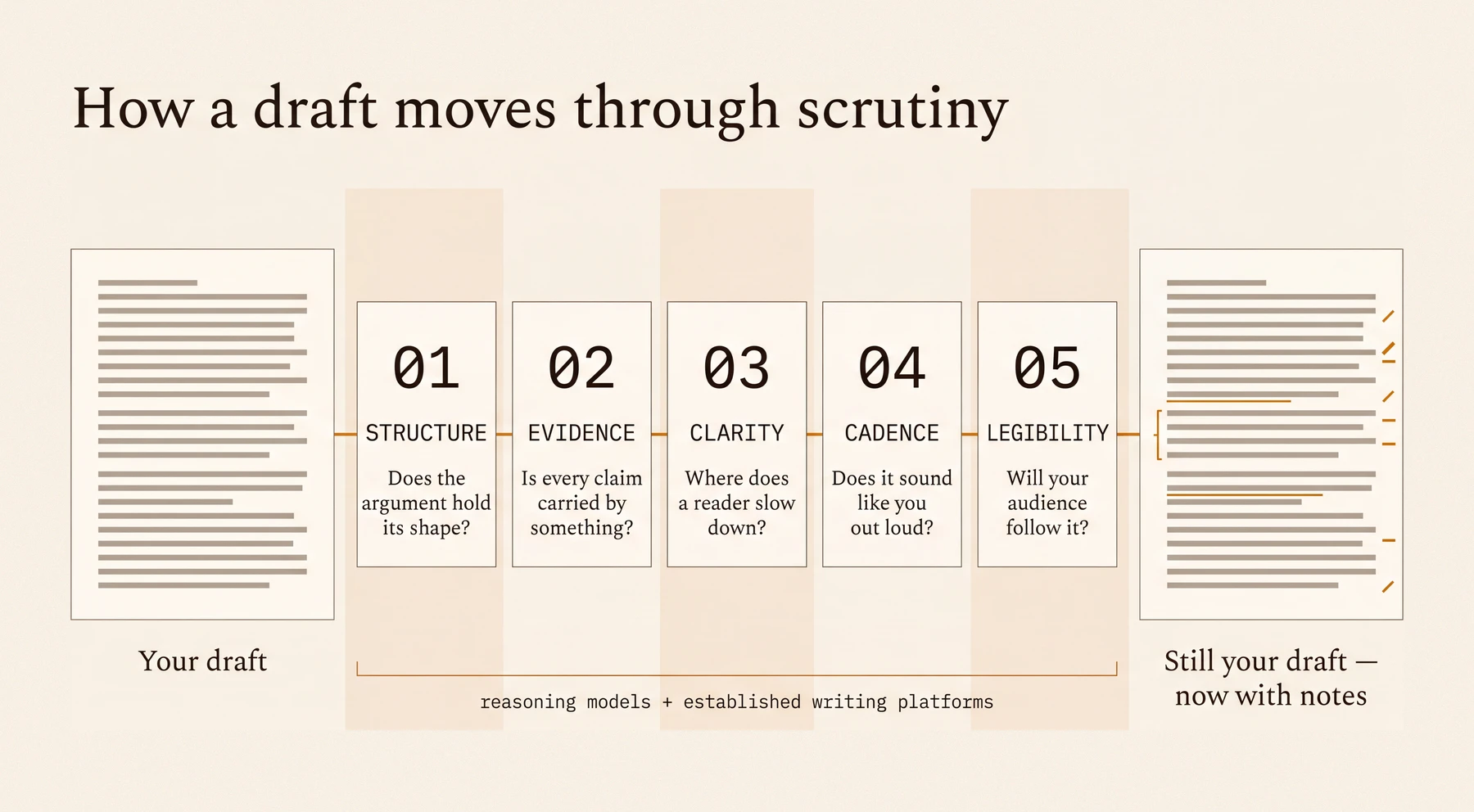
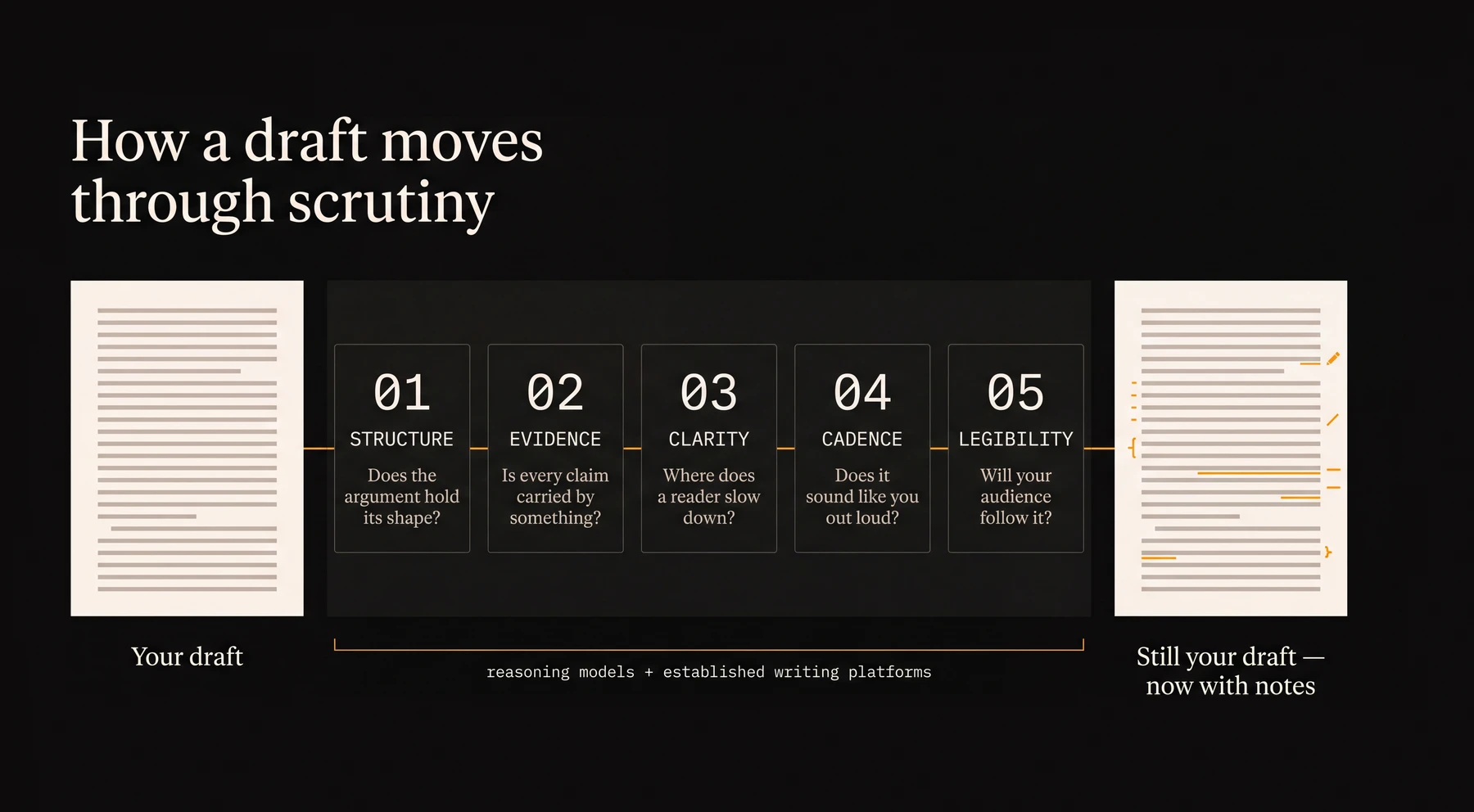
It goes through a pipeline. Reasoning models argue with the structure of what you said. Established writing platforms check what a reader will actually do with it. Each stage looks for one thing, and each stage has to show its work.
building the pipeline…
-
01
Structure
Does the argument hold its shape?
Reasoning models read the piece as an argument rather than as prose. They find the claim you are actually making, then check whether your paragraphs are in the order that claim needs.
-
02
Evidence
Is every claim carried by something?
Where you assert, the pipeline asks what is holding it up. It will not invent a source or fill the hole for you. It marks the gap and tells you your reader is going to find it.
-
03
Clarity
Where does a reader slow down?
Sentence-level passes flag the clause carrying two ideas, the pronoun with no owner, the opening that makes somebody read the line twice before they get it.
-
04
Cadence
Does it sound like you out loud?
Measured against your own earlier writing and the voice you set in your profile. If you have drifted into a register that isn’t yours, this is the stage that says so.
-
05
Legibility
Will your audience follow it?
The last pass reads the piece as the person you said you were writing for. The jargon you never defined, the context you assumed, the paragraph where they would stop.
A paragraph can be reorganised without a single word being rewritten.
This is the part almost nobody builds, because rewriting is easier to ship and easier to demo. Sulat questions the skeleton and leaves the flesh alone.
sorting the sentences…
Sulat treats your paragraph as a stack of load-bearing sentences. It asks which one is actually the claim, which ones are the support, and which one you buried because you were nervous about it. Then it proposes an order.
You can watch the whole move happen and count the words that changed. There are none. The sentences travel intact, keep their punctuation, keep their tics, keep the joke in the middle you were slightly embarrassed about. What changes is the sequence a reader meets them in, and that is usually the entire problem.
If you reject the proposed order, nothing happens to your file. Sulat has no write access to your draft, by design and not as a setting you can turn off.
Sentences moved0 Words rewritten0
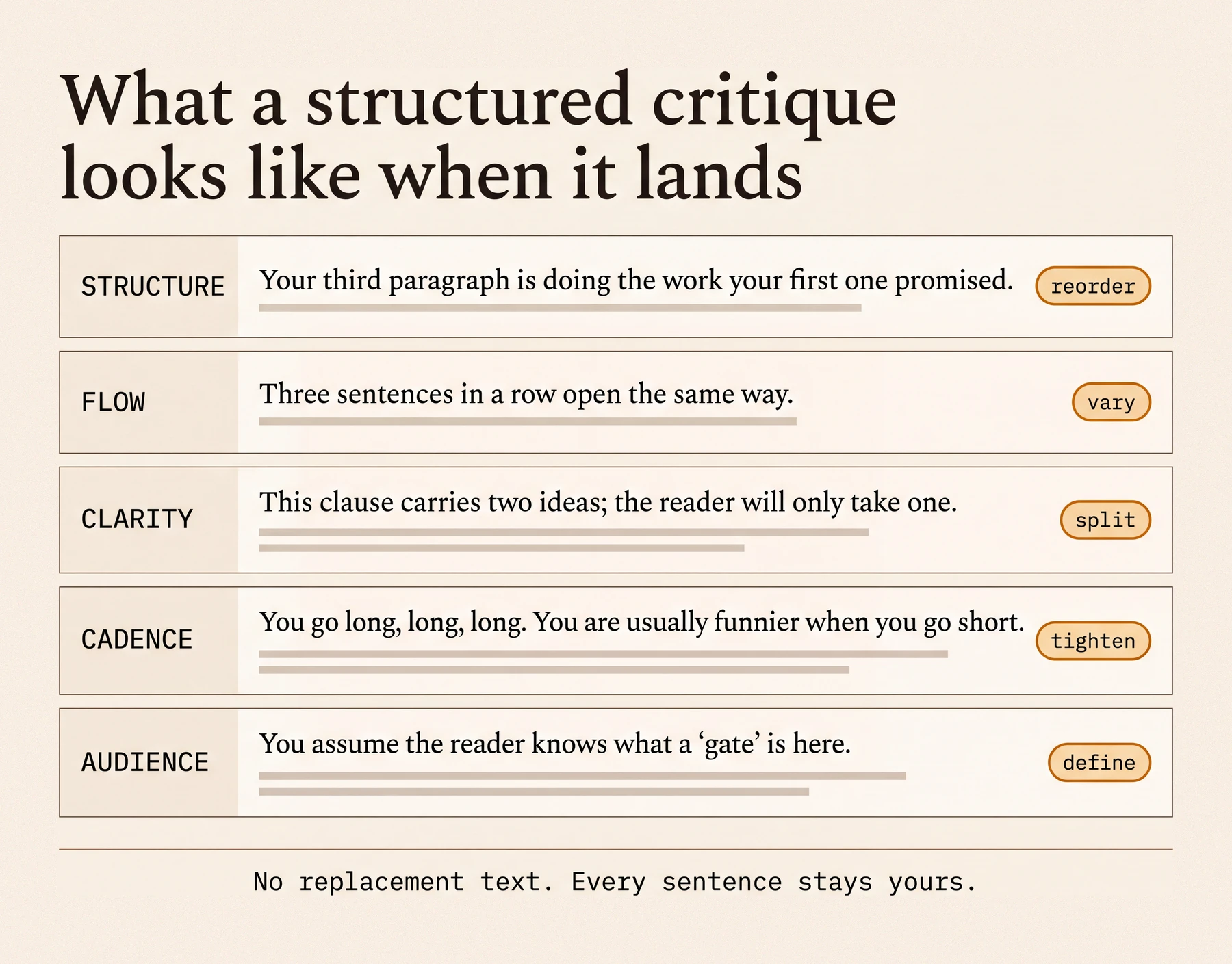
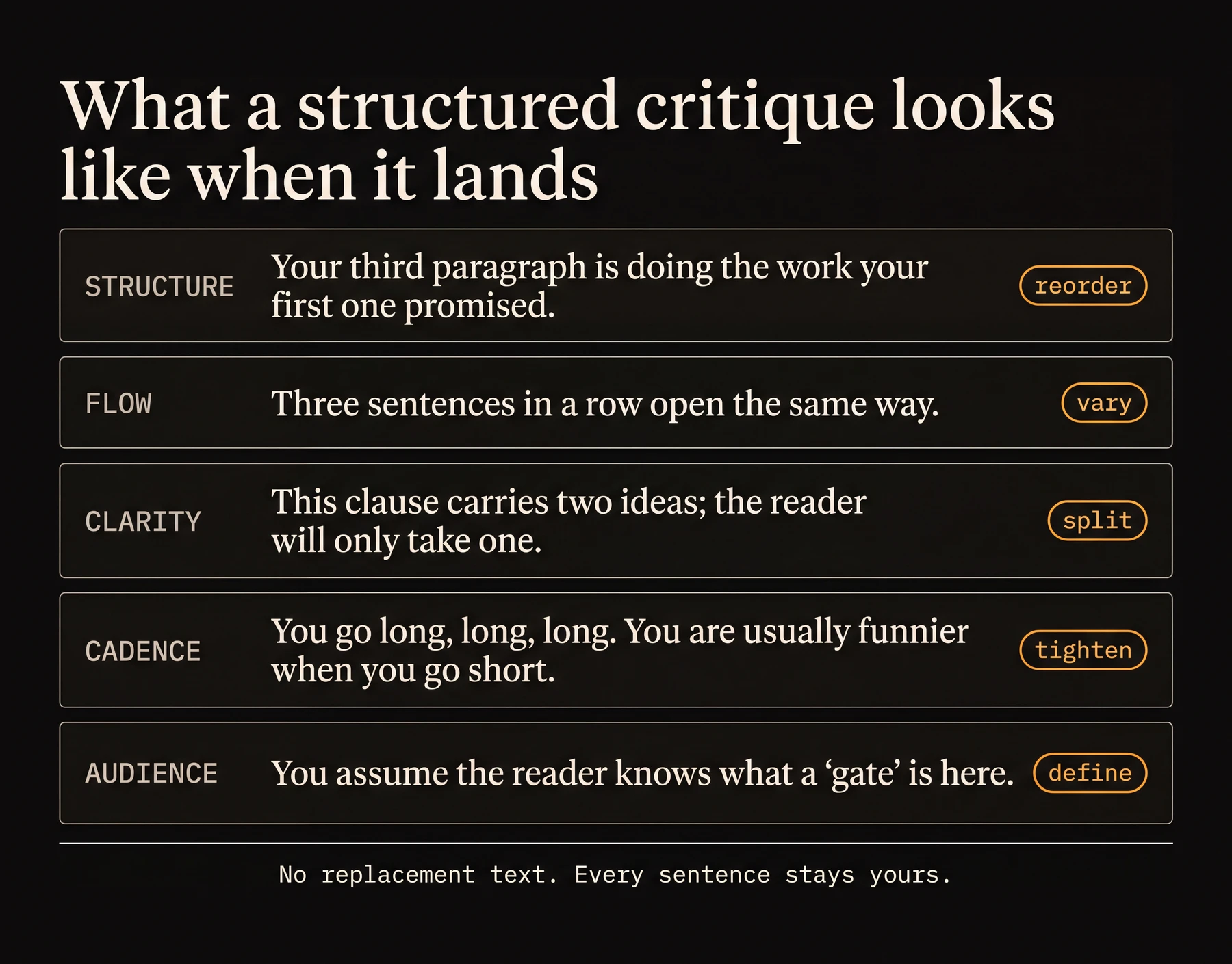
The critique lands as a document you can argue with.
Not a score. Not a green tick. A set of named observations, each attached to a specific stretch of your writing, each carrying the reason it was raised — so you can look at one and decide it is wrong.
It has to be specific
“Tighten this up” is not a critique, it is a mood. Every note points at a span you can highlight and says what is wrong with that span in particular.
It has to be refusable
You are the author. Dismiss a note and Sulat records that you dismissed it, and stops making the same one at you next month.
It has to teach
Each note names the pattern, not just the instance, so the twentieth draft needs fewer notes than the first. That is the only thing here worth calling progress.
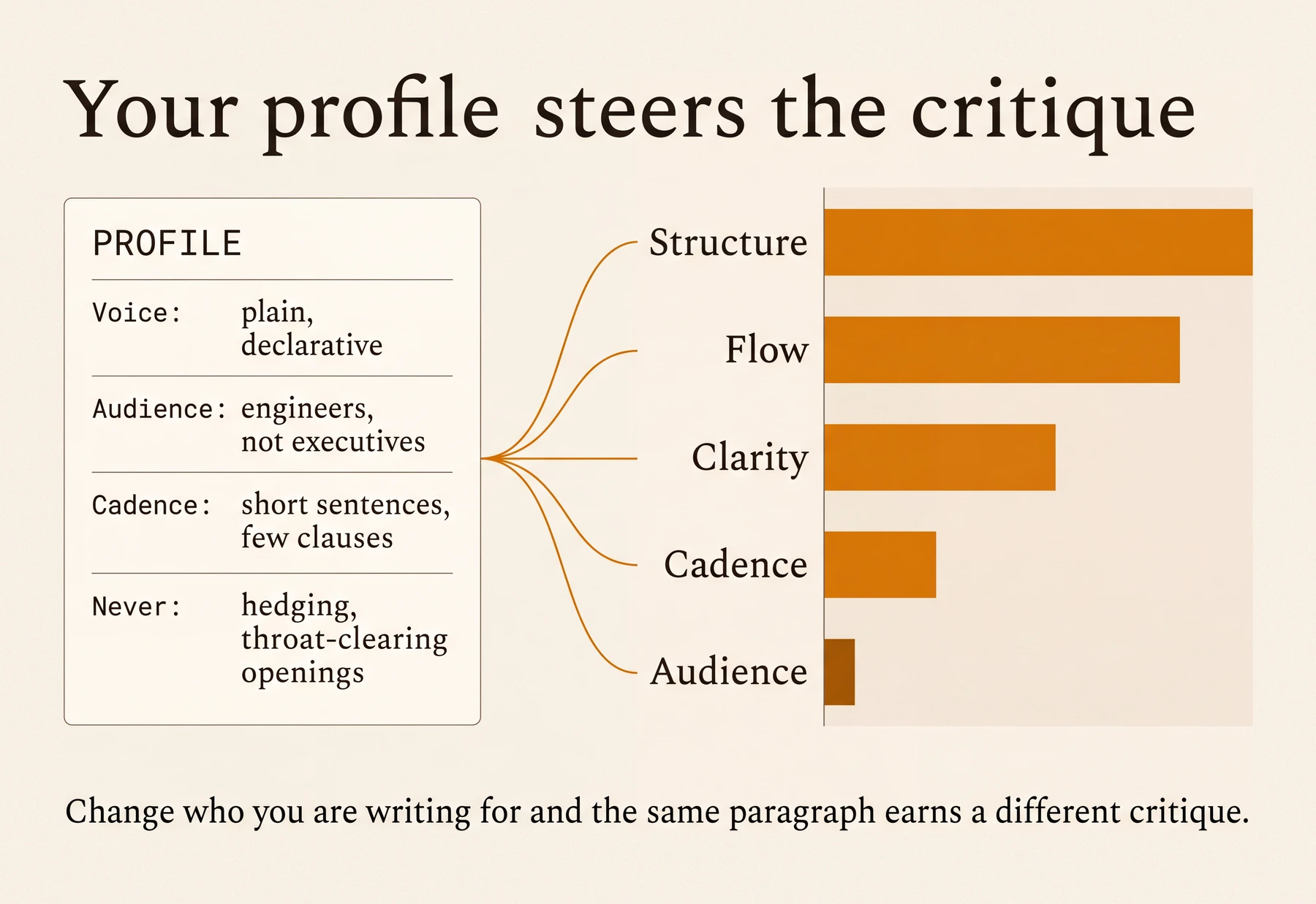
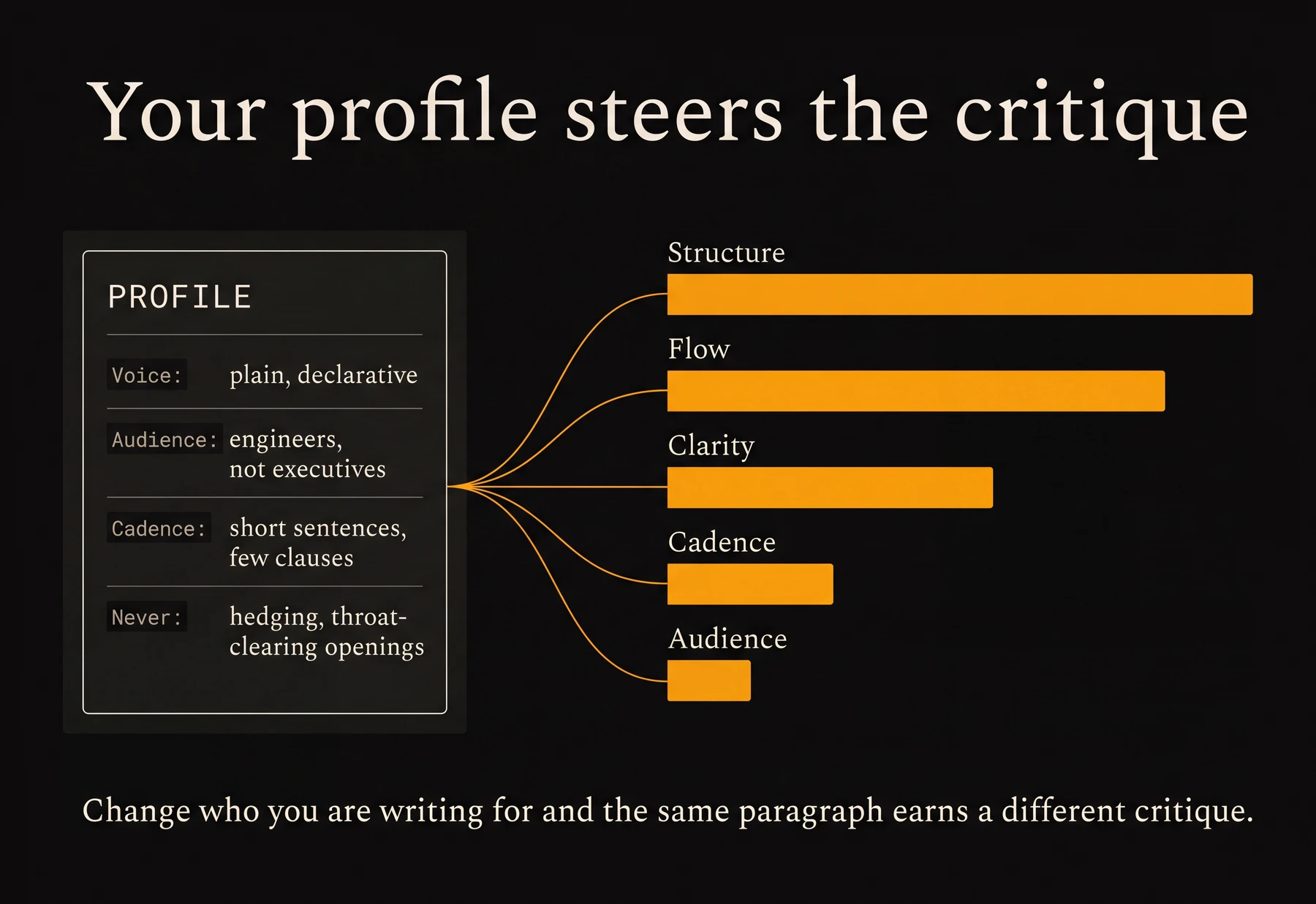
The critique is calibrated to you, or it is just somebody’s taste.
Before Sulat reads a word, it reads your profile. Who you write as, who you write for, and the things you refuse to do. That is why the same paragraph earns a different critique from yours than it does from mine.
“It is worth noting that the migration may potentially introduce some degree of latency for a subset of users.”
Built for people who can tell readable from interchangeable, and refuse to trade one for the other.
- Writers with taste and deadlines. You already know what good looks like. What you need is somebody to tell you, at 11pm, which of the four things bothering you about this draft is the real one.
- Engineers, founders and operators. The memo, the design doc, the incident write-up, the post your team has to act on. Documents where being misread has a cost by Friday.
- Anyone writing in a second or third language. You want to be legible without being sanded down into somebody else’s idiom. Sulat marks what will trip a reader and leaves your voice where it is.
- Anyone who has pasted their own paragraph into a chatbot, got back something smoother, used it, and felt slightly worse about themselves afterwards. That feeling was accurate. This is the tool for it.
Sulat will run on the phone you already have, and it will be priced for people who write because the job demands it, not only for people paid to write. It is also built to make itself less necessary: that is the difference between being taught and being covered for. Getting better at writing should not be a luxury tier.
What it actually feels like to use.
No dashboard tour. This is the shape of one real sitting.
-
23:04
You paste 800 words you have to send in the morning. No formatting to fix, no template to pick. Sulat wants the draft in the state you actually left it in, including the bracketed note to yourself in paragraph four.
-
23:04 + 90s
The pipeline runs and the stations report one by one. Structure comes back first because it is the cheapest to be wrong about. Legibility comes back last because it needs everything the others found.
-
23:06
Twenty-two notes. You disagree with six. Good. You are the author and you know things the pipeline does not, like who is going to read this and what they said in the meeting. Dismiss them; it learns.
-
23:19
You fix eleven things yourself. Nothing was fixed for you. You moved the buried claim to the front, cut a hedge, defined a term, and killed the second paragraph entirely because the critique made it obvious it was doing nothing.
-
23:24
You send it. It reads like you on a good day. Which is the highest thing a piece of writing can do, and the one thing a rewrite can never give you.
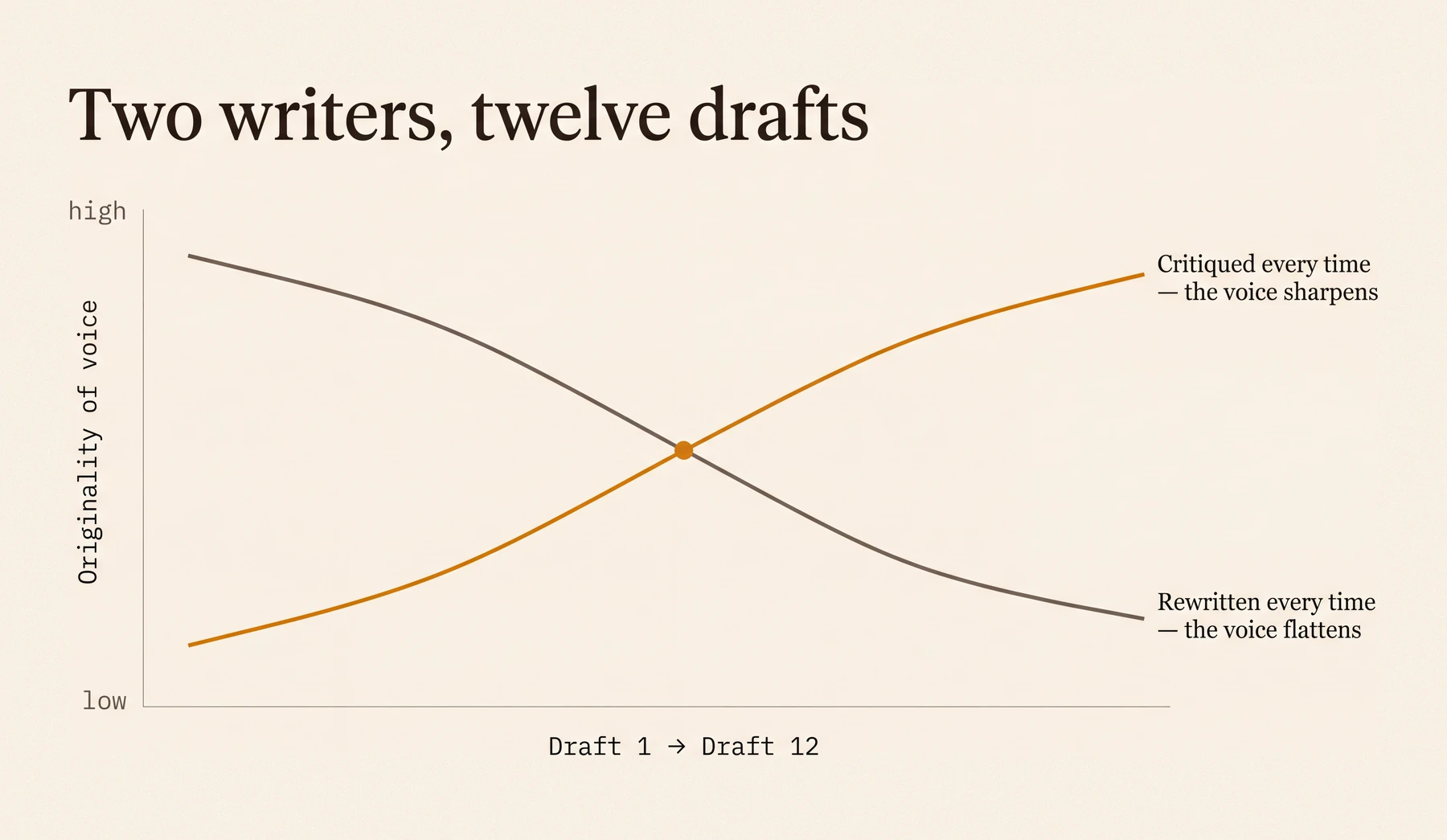
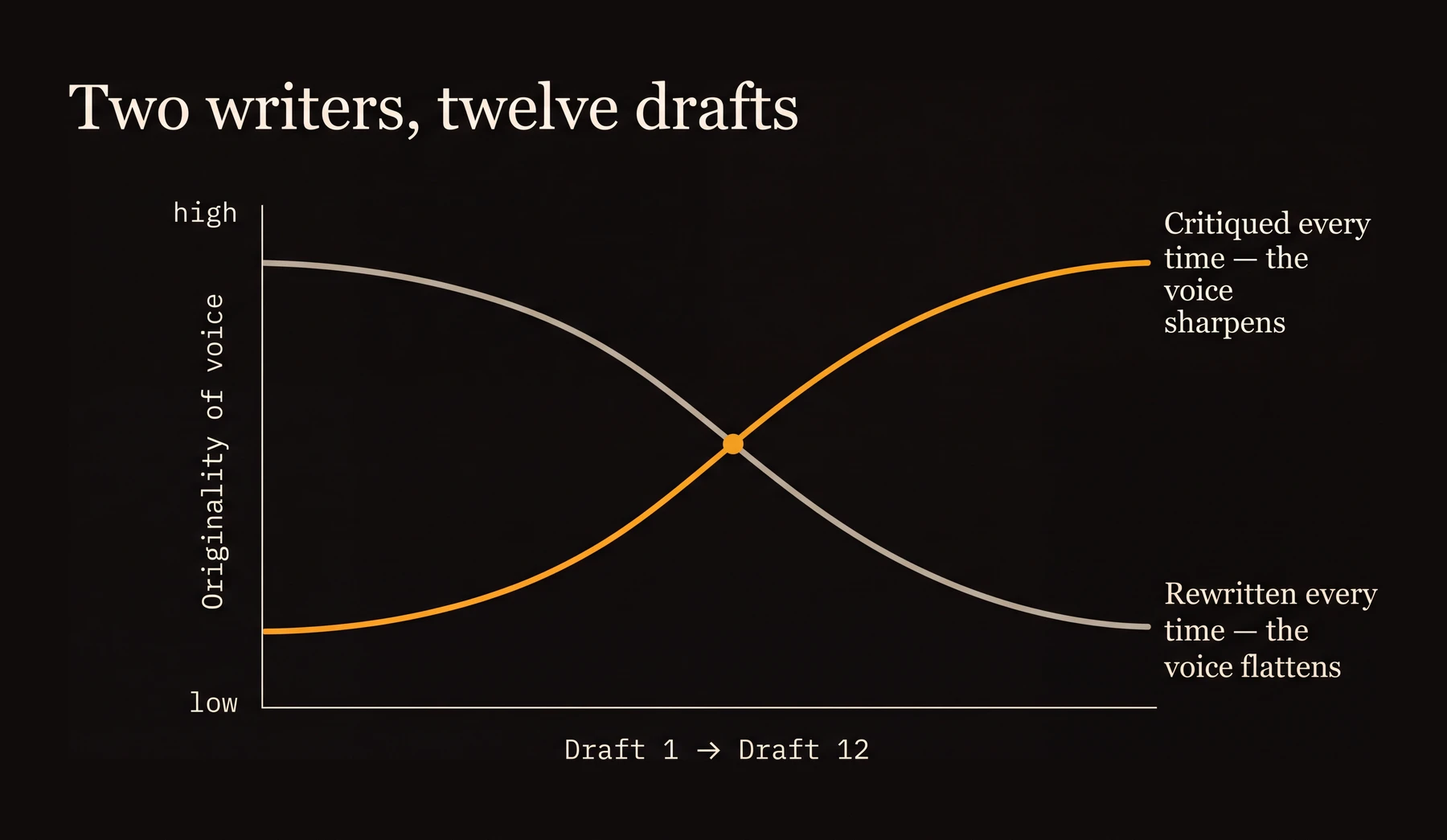
Fluency you rent, or fluency you own.
Every accepted rewrite gives you a better document and a slightly worse writer. The gain is real and it is borrowed. Structured critique is slower, and it compounds the other way.
The rented curve
It starts higher. That is the whole trap. The first rewrite is genuinely better than what you would have written, so you take it, and the second one, and by the fortieth you have no idea whether you could have done it yourself, because you have not tried in four months.
The owned curve
It starts lower and it is more work. You get told the third paragraph is doing the first one’s job, and then you have to go and fix it. Six weeks later you catch that pattern yourself, before you write it, which is what getting better has always meant.
closed alpha
Ask for a place in the alpha.
There is no form on this page and there is not going to be one. Write to the address below and tell us what you write, who reads it, and what keeps going wrong when you sit down to do it. A person reads every one of these.
alpha access investor enquiries a real person, not a queue
Long-press or tap the address to select the whole thing, or use the copy button. If your device has no mail client, the address is plain text and always will be.
settling the page…